Mexico
Naked LunchMexico serves as a passage in the narrator’s journey and as a setting where local drug networks meet state regulation. The border crossing changes the landscape and the terms of perception, while Mexico City presents supply as a mix of government scripts, personal connections, and persistent dependence.
Crossing into Mexico
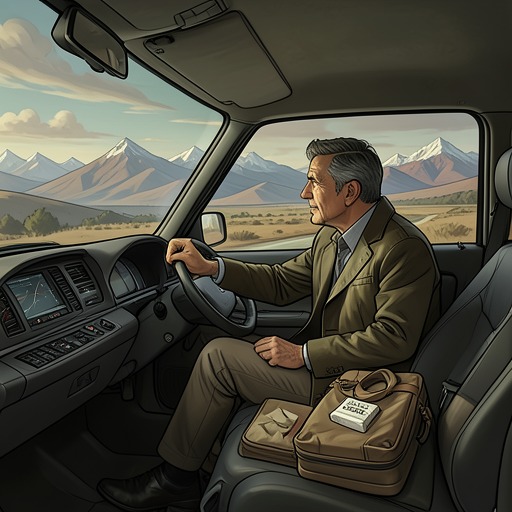
After traveling through Texas and Louisiana, the narrator describes crossing the border into Mexico as an abrupt change: the landscape seems to arrive without anything between it and the travelers. Desert, mountains, and vultures dominate the account. The journey continues through the night, reaching a town at dawn, where the narrator identifies the place as Thomas and Charlie and notes its dramatic elevation: it lies at sea level, with a climb of ten thousand feet ahead. The narrator then sleeps in the back seat while a woman drives.
This passage gives Mexico a forceful geographical presence rather than treating it merely as a destination. The border marks a perceptual break, and the shift from the road through the southern United States to Mexico’s open landscape is rendered through direct observation. The account, however, remains embedded in the practical movement of a drug-seeking journey.
Drug supply and local connections
The narrator’s account of Mexico City centers on Lupita, who distributes small papers of poor-quality drugs. She observes that selling can become more habitual than using: pushers who do not consume may nevertheless develop a contact habit, a dependence formed through their place in the trade. The example of Bradley the Buyer extends the point from local seller to narcotics agent. Though an official, he can approach a pusher and obtain drugs directly; his anonymity makes him difficult to remember. The passage thus places Mexico City within a wider network in which the roles of user, seller, and enforcement agent do not remain cleanly separate.
A separate account describes a practical method of obtaining drugs in Mexico: find a local addict with a government script authorizing a monthly quantity. The narrator’s source for this arrangement is Old Ike, who had spent most of his life in the United States. The detail makes regulation part of the supply system without suggesting that it displaces informal exchange. Access depends on both an official allowance and a local intermediary.
Mexico in the book’s wider network
Mexico is also one node in a transnational world of addiction. The narrative places Mexico City alongside Yemen, Paris, New Orleans, and Istanbul, connecting users across distance through the recurring demands of the drug economy. In the narrator’s description, people in different cities are bound by shared dependence and withdrawal, even as the settings and local arrangements differ.
That network does not make Mexico interchangeable with every other place. Mexico has its own routes, intermediaries, and procedures: the border crossing, Lupita’s distribution, and the government-script arrangement all give it a specific place in the account. Together, these details present Mexico as both a country traversed by the narrator and a distinct setting in the book’s larger map of addiction, commerce, and control.